


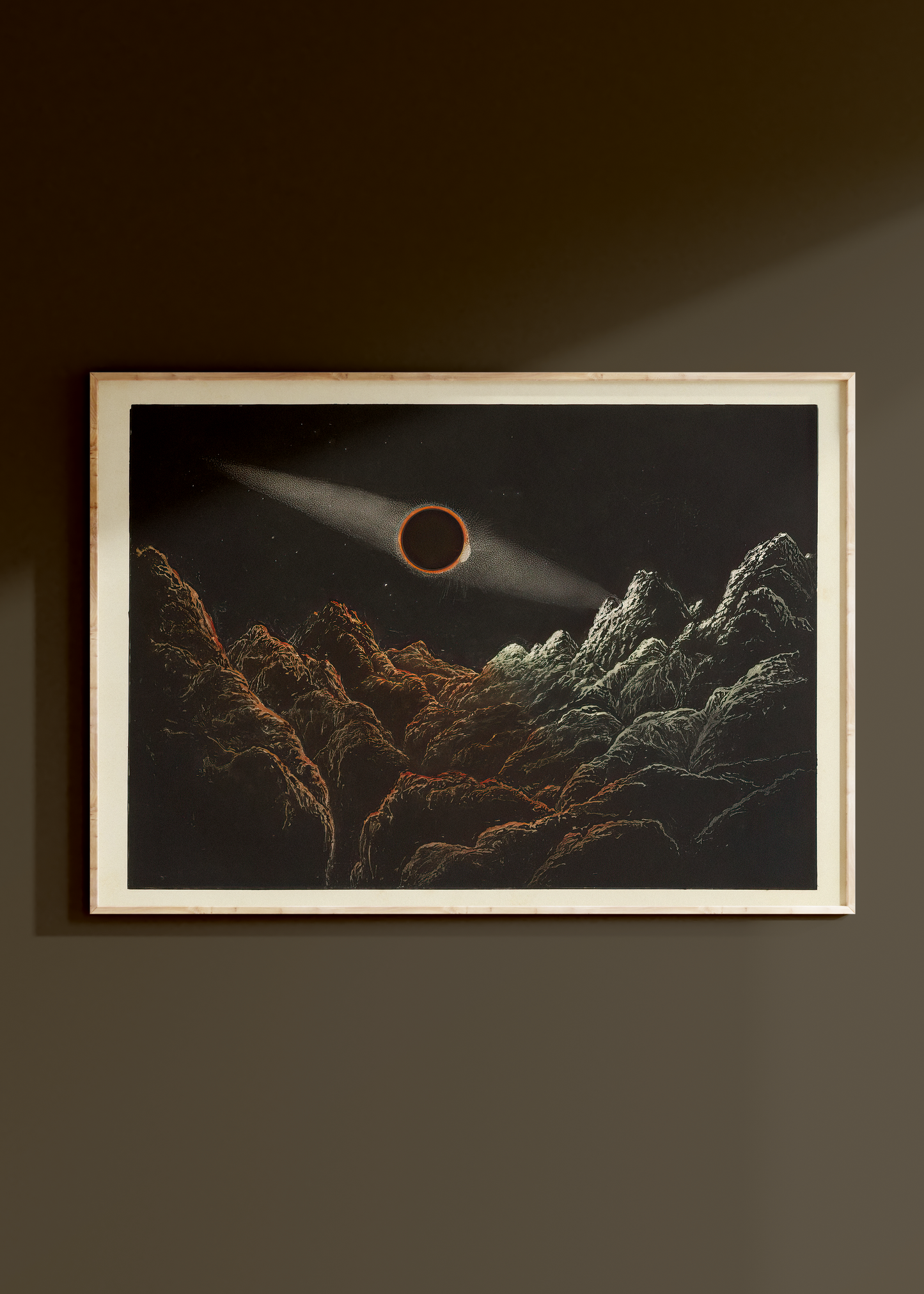
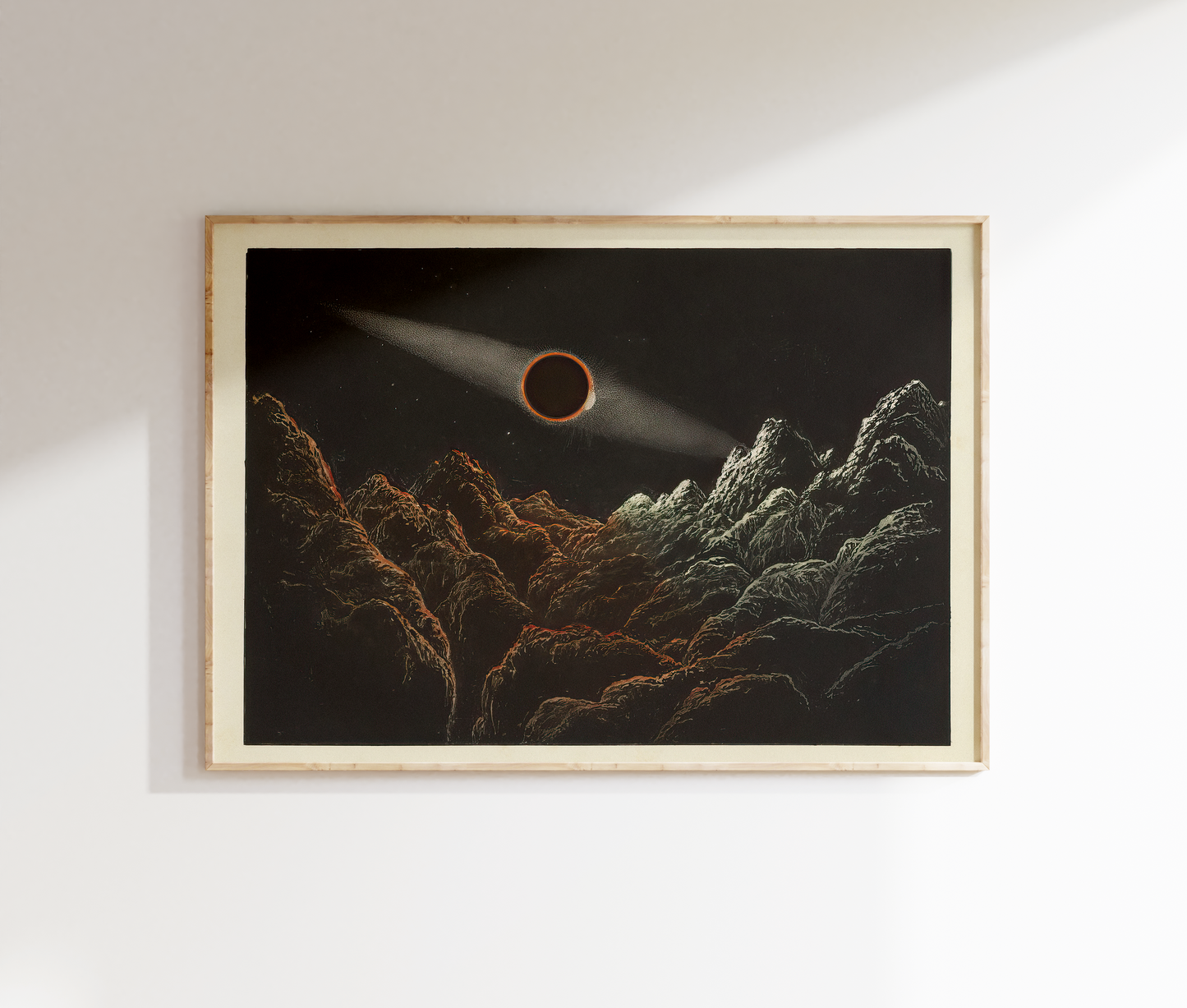
Aspect of an eclipse of the sun by the earth as it would appear as seen from the moon, 1874
Aspect of an eclipse of the sun by the earth as it would appear as seen from the moon, 1874
What would a solar eclipse look like from the Moon?
Rather than simply imagining the answer, James Nasmyth combined astronomy, carefully constructed models and photography to create a view no human had ever seen.
Couldn't load pickup availability
Aspect of an Eclipse of the Sun by the Earth as it Would Appear as Seen from the Moon was published in 1874 in The Moon: Considered as a Planet, a World, and a Satellite. Created by James Nasmyth and James Carpenter, it depicts a solar eclipse as it would appear from the Moon, a view no human had ever witnessed.
Rather than relying on imagination alone, Nasmyth based his work on telescopic observations, carefully constructed plaster models and photography, helping readers visualize the Moon as a real landscape.
The result is one of the nineteenth century’s most original scientific illustrations, where astronomy, craftsmanship and visual storytelling come together to make the unseen believable.
Restored from the original and reproduced as a museum-quality fine art print.
The Story
The Story
James Nasmyth was not only an engineer and inventor, but also an accomplished amateur astronomer. Working with James Carpenter, he set out to create one of the most detailed books on the Moon published during the nineteenth century.
Because photography of the lunar surface was still limited, Nasmyth developed an ingenious solution. He sculpted highly detailed plaster models based on telescopic observations, illuminated them to reproduce the angle of sunlight on the Moon, and then photographed the models. The resulting images conveyed the Moon’s landscape with an extraordinary sense of realism.
Although many of Nasmyth’s geological interpretations, including his belief that lunar craters were volcanic, have since been revised, the book remains a landmark in the history of astronomy for its innovative combination of observation, craftsmanship and visual communication.
This illustration reflects that same spirit. It is not a record of something that had been seen, but a scientifically informed attempt to picture a view from another world.
Editor’s note
Editor’s note
We spend our lives looking at the Moon from Earth. Here, for a moment, we are invited to stand somewhere else and look back.
Like many of my favourite scientific illustrations, it is both rigorous and imaginative. It shows that sometimes understanding begins by learning to see the familiar from an entirely different place.
Restoration
Restoration
This image has been carefully prepared for fine art printing.
Dust, stains, scanning artifacts, and tonal inconsistencies are corrected by hand where needed. The file is then checked for sharpness, tonal range, and print quality.
The goal is not to redesign the original, but to preserve its character while making it suitable for contemporary printing.
Materials
Materials
Printed on Hahnemühle 308 gsm museum-quality fine art paper with a matte finish, or available as a premium 400 gsm canvas mounted in a handcrafted wooden float frame.
Paper prints are shipped unframed and wrapped in acid-free tissue paper.
Shipping
Shipping
All the artwork is printed to order in as little as 2-3 days. We ship everything for free worldwide.
Share



Our artwork is printed on Hahnemühle Fine-Art 308 gsm paper, founded in Germany in 1584 Hahnemühle makes one of the best fine-art paper available today.
The image is very cool, but the paper that was used is really what adds to it. Quality paper matters with prints, I think that attention to detail matters.