


Black Hole, 1979
Black Hole, 1979
Couldn't load pickup availability
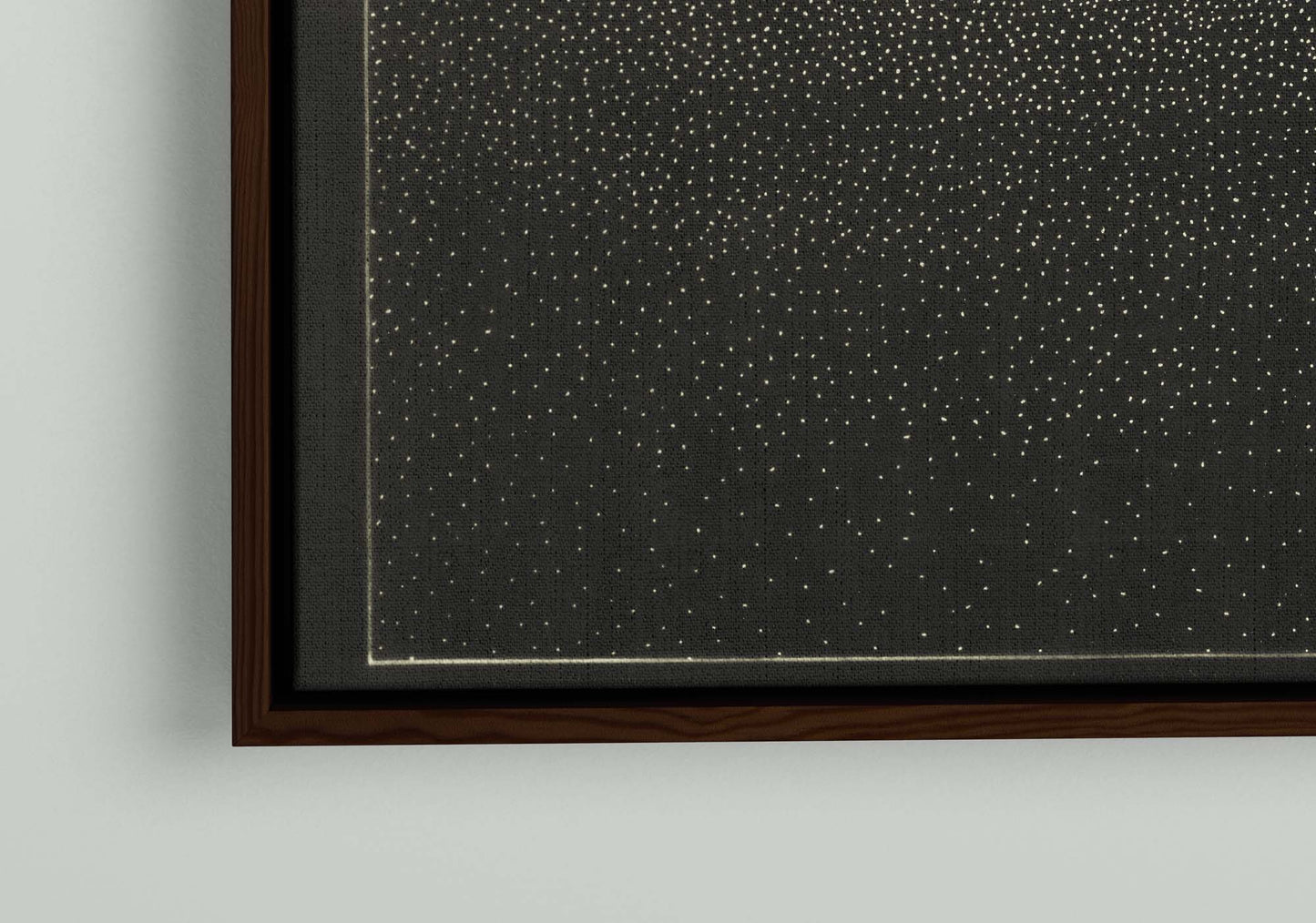
Published in 1979, Black Hole (Image of a Spherical Black Hole with Thin Accretion Disk) by Jean-Pierre Luminet became the first scientifically accurate visualization of a black hole.
There was no photograph to work from. Using an IBM 7040 computer, Luminet calculated how gravity would bend light around a black hole before meticulously translating the results into a hand-drawn image using India ink on photographic negative paper.
The image was based entirely on mathematics. Forty years later, in 2019, the Event Horizon Telescope released the first direct image of the supermassive black hole at the centre of the galaxy Messier 87.
The resemblance was striking, confirming just how remarkably accurate Luminet’s calculations had been.
Restored from the original and reproduced as a museum-quality fine art print.
The Story
The Story
A black hole is not simply a dark object.
It is a region where gravity becomes so strong that nothing, not even light, can escape once it crosses the event horizon. Around it, matter forms an accretion disk: a ring of gas heated to extraordinary temperatures as it spirals inward.
That is what Luminet set out to visualize.
His calculations predicted how gravity would distort the light from the disk. The far side appears lifted above the black hole. The lower half appears brighter because the material is moving toward the observer at enormous speed.
For decades, this image remained the closest anyone could come to seeing a black hole.
Editor’s note
Editor’s note
A black hole is one of the most extreme objects in the known universe.
It bends space and time. It tears stars apart. It traps light itself.
Yet this image is remarkably quiet.
It was made to understand, not to impress.
Also available with a white background as the Original Drawing Edition, reflecting the appearance of Jean-Pierre Luminet’s original India ink drawing before it was reproduced as a photographic negative.
Restoration
Restoration
This image has been carefully prepared for fine art printing.
Dust, stains, scanning artifacts, and tonal inconsistencies are corrected by hand where needed. The file is then checked for sharpness, tonal range, and print quality.
The goal is not to redesign the original, but to preserve its character while making it suitable for contemporary printing.
Materials
Materials
Full image print
Fills the page and retains the thin white outline of the original image.
Printed black border
Adds a wide black surround for a quieter, exhibition-like presentation.
Fine Art Paper
Printed on Hahnemühle 308 gsm museum-quality fine art paper with a matte finish.
Sold unframed and wrapped in acid-free tissue paper.
Canvas
Printed on premium 400 gsm canvas and mounted in a handcrafted wooden float frame, ready to hang.
Care
Allow paper prints to rest for about 24 hours before framing. Place them between tissue paper under a few large books to help them flatten naturally after shipping.
Shipping
Shipping
All the artwork is printed to order in as little as 2-3 days. We ship everything for free worldwide.
Share



Our artwork is printed on Hahnemühle Fine-Art 308 gsm paper, founded in Germany in 1584 Hahnemühle makes one of the best fine-art paper available today.
The item was securely shipped and is of great quality! I am very pleased with the product!
Looks awesome in a black frame
very high quality! would recommend
Absolutely incredible print quality and paper quality!
Very happy with this purchase!