


The Changing Faces of Mars and Venus, 1892
The Changing Faces of Mars and Venus, 1892
The planets never change size.
Only our perspective does.
Couldn't load pickup availability
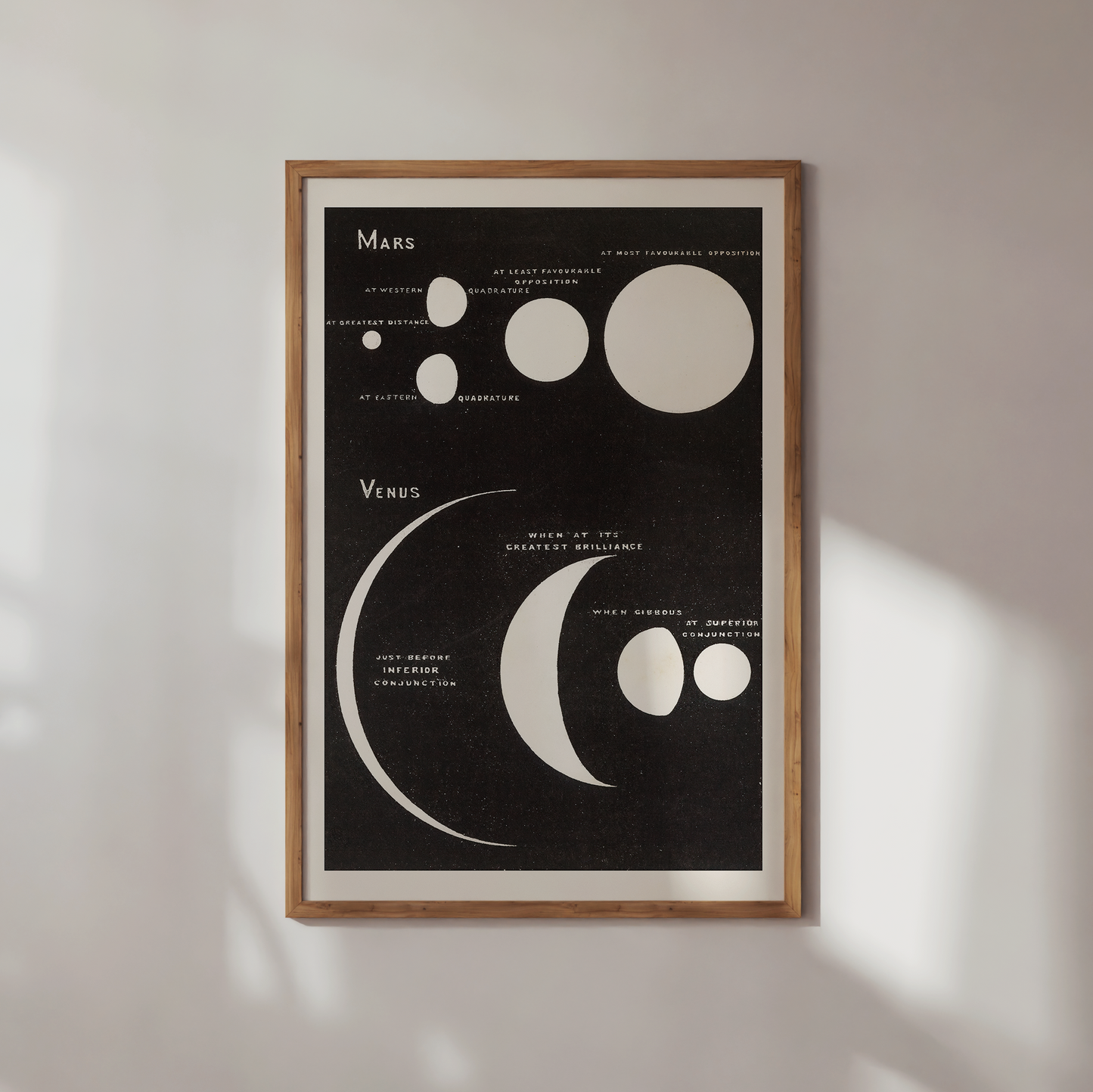
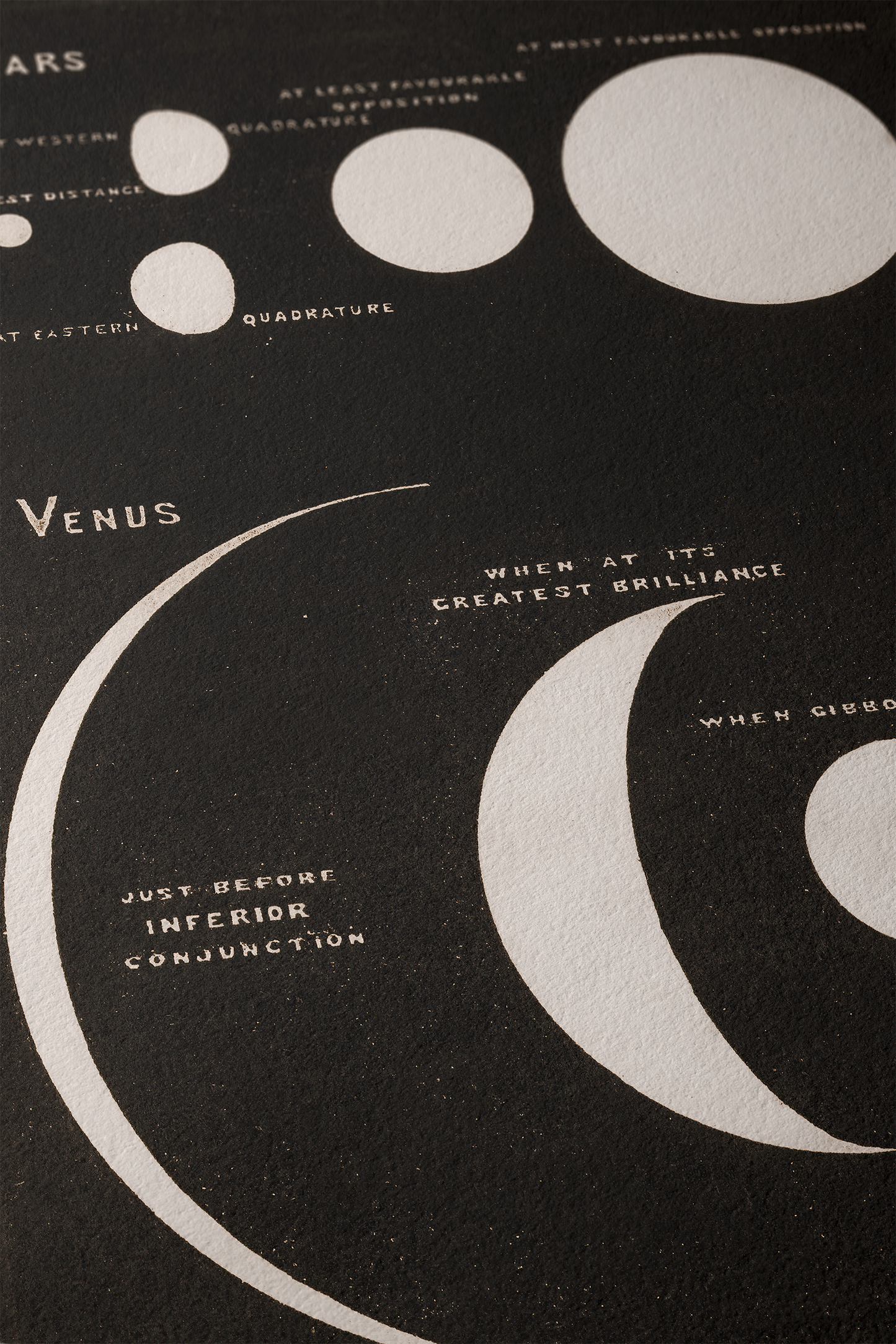
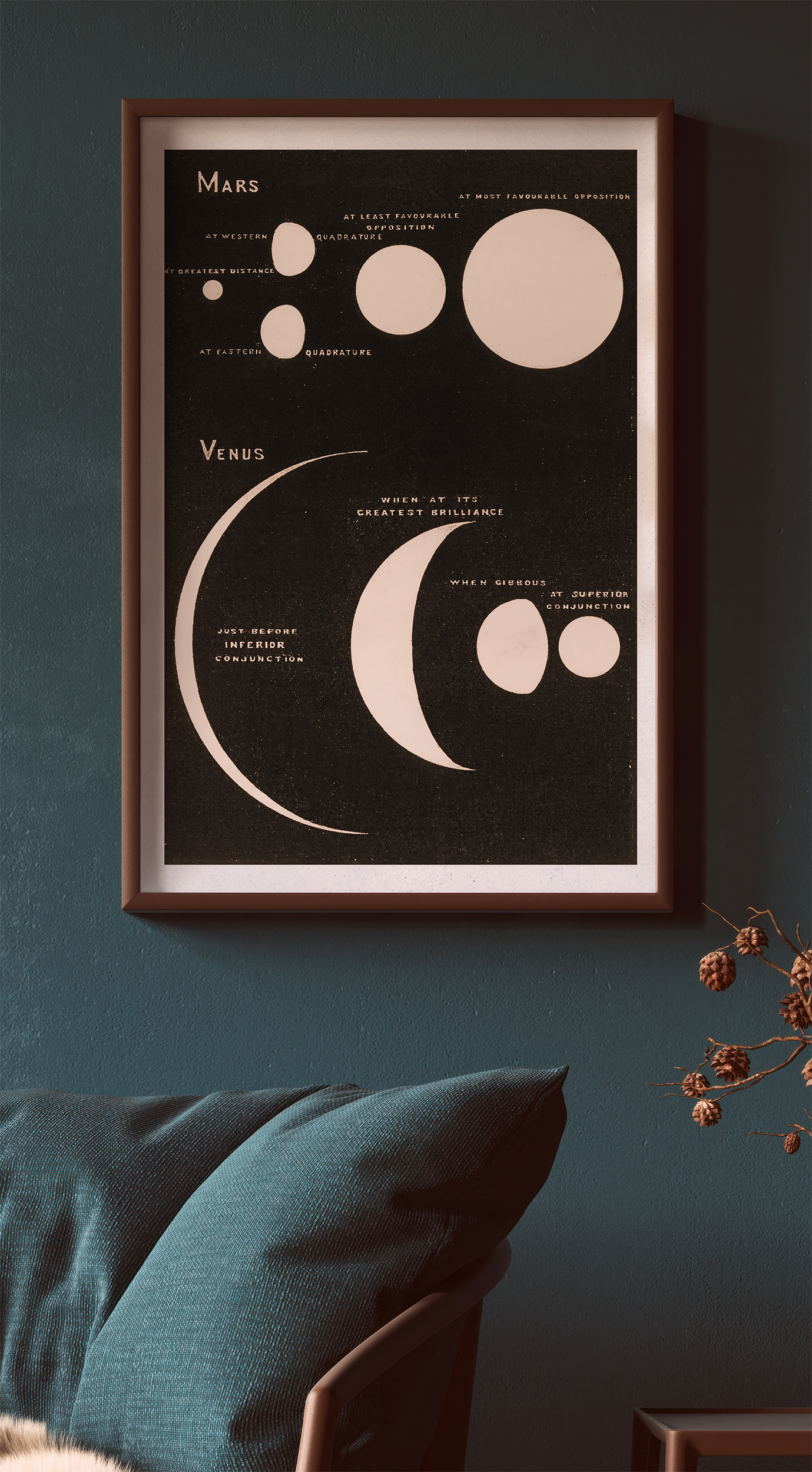
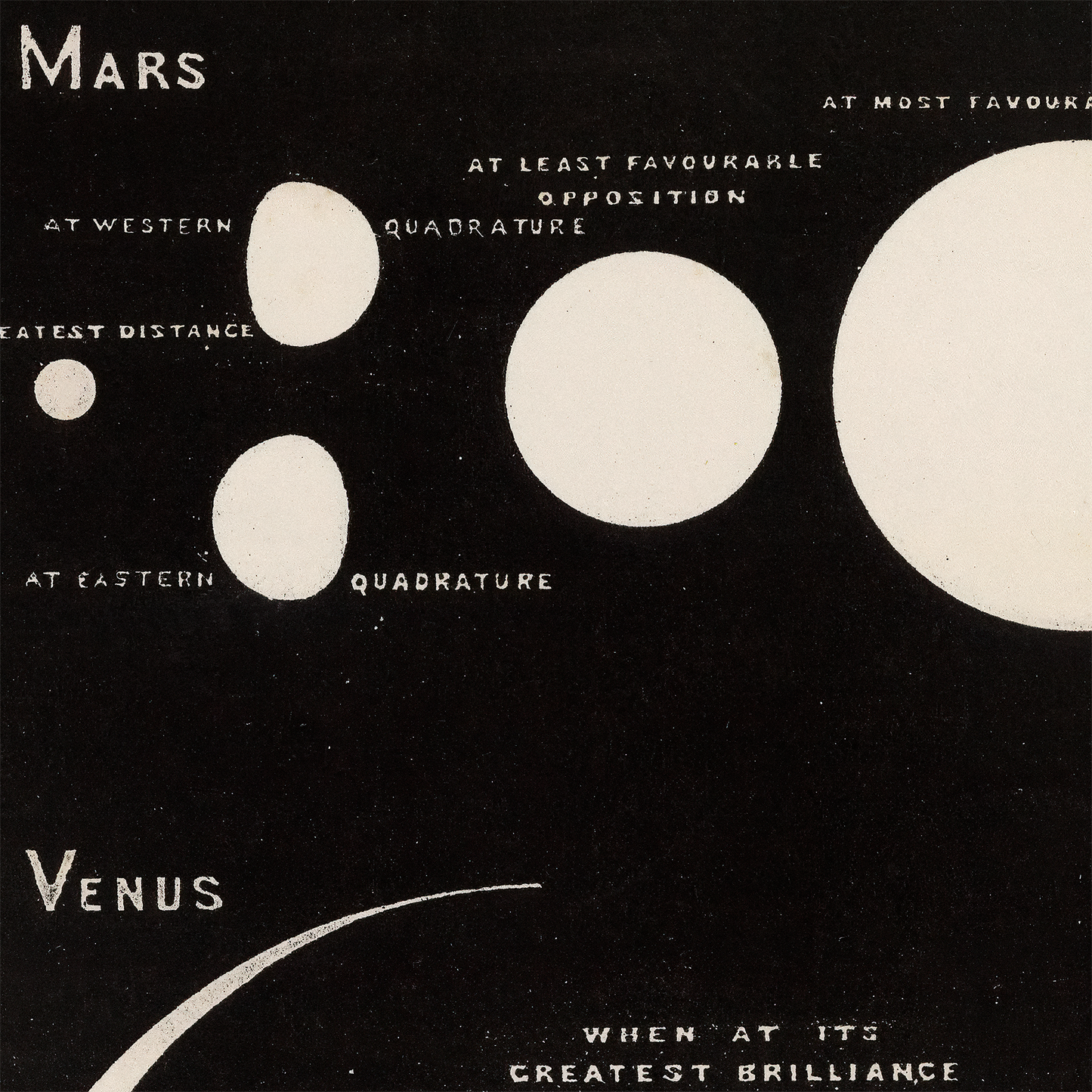
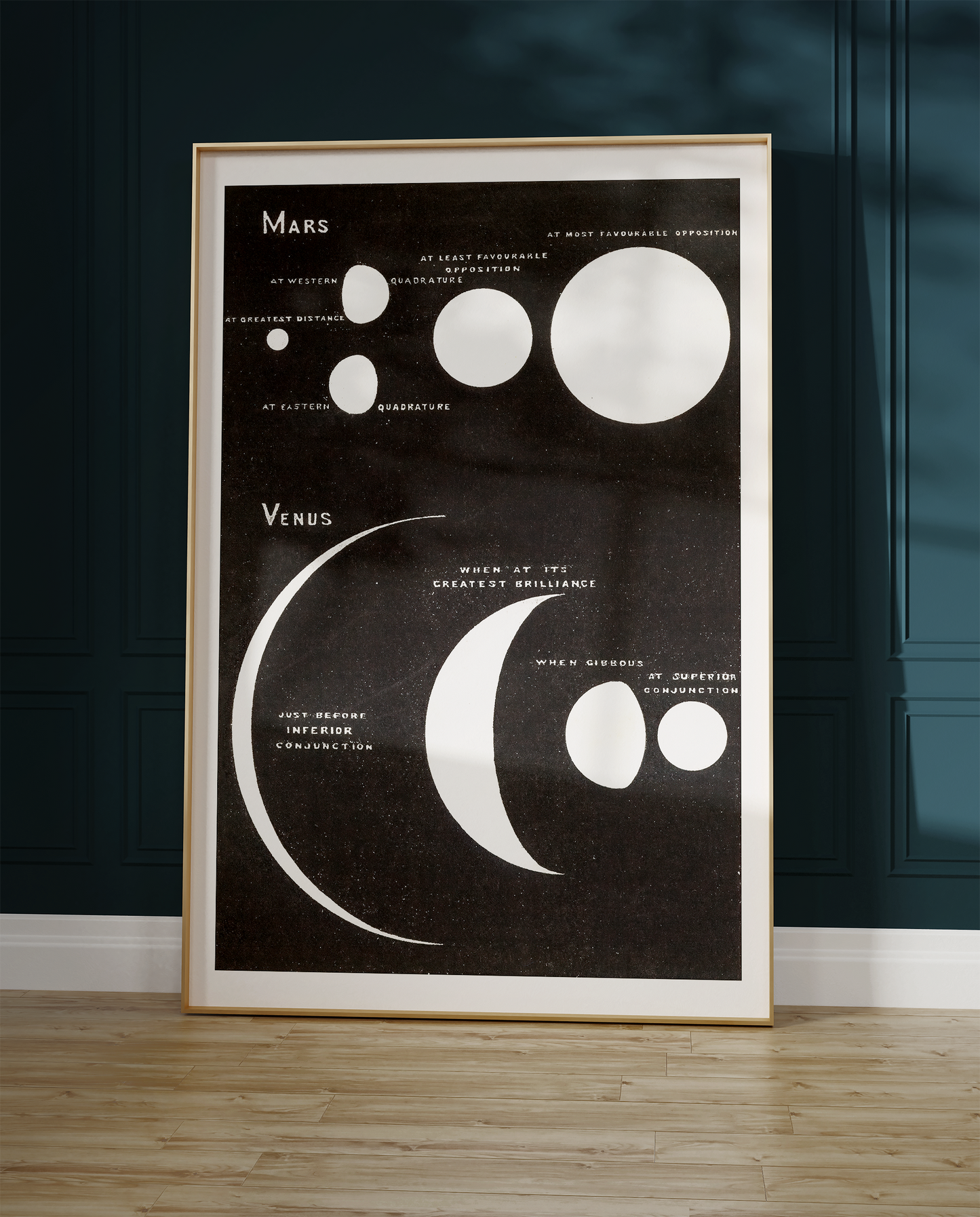
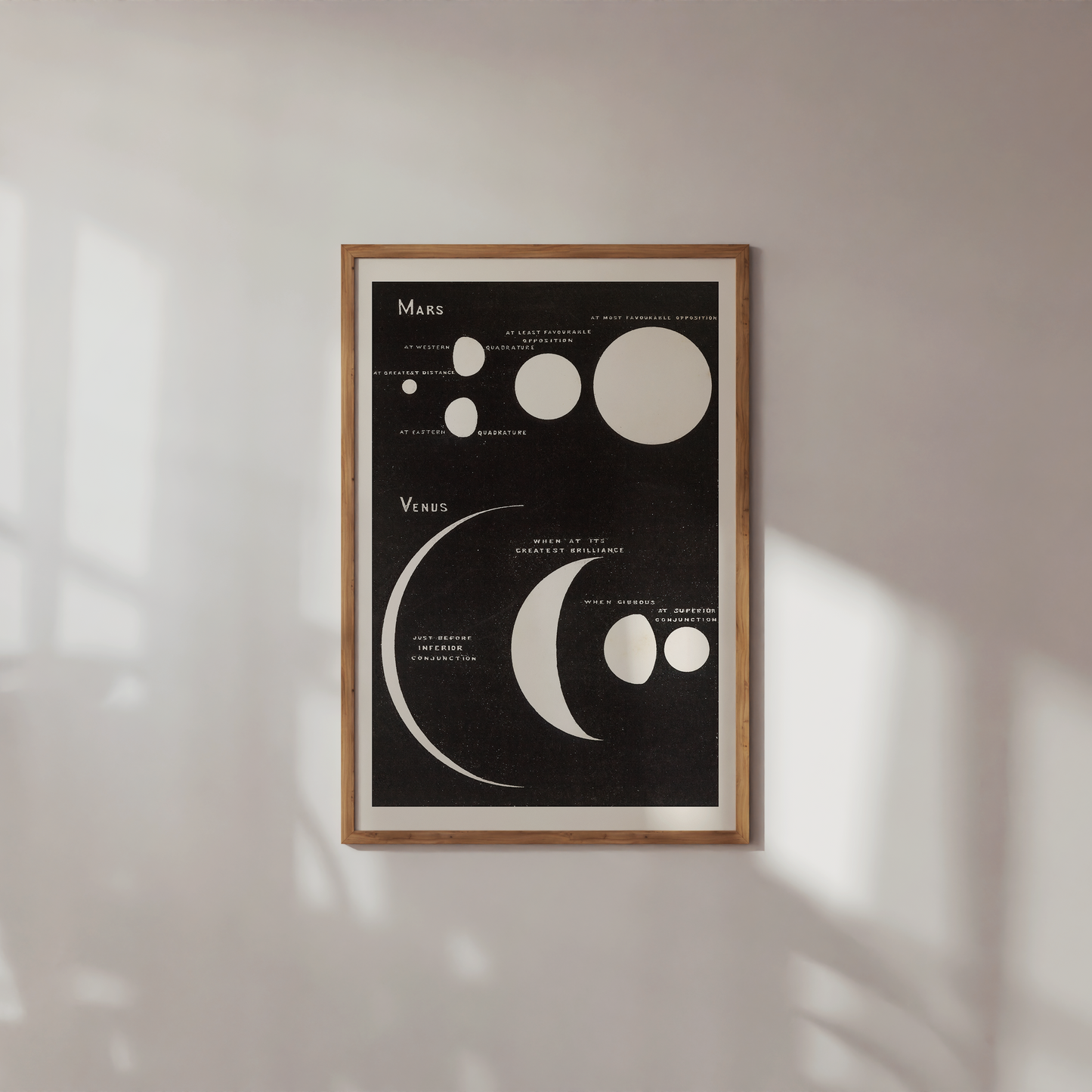
The Changing Faces of Mars and Venus was published in 1892 in Robert Stawell Ball’s An Atlas of Astronomy. This elegant diagram compares the changing apparent sizes of the two planets as seen from Earth.
The planets themselves remain the same. As they move through their orbits, however, their distance from us changes dramatically. To nineteenth-century astronomers, these shifting discs were more than visual curiosities. They were essential clues for measuring the architecture of the Solar System.
Simple, graphic and almost abstract, the illustration transforms orbital mechanics into something immediately visible.
Restored from the original and reproduced as a museum-quality fine art print.
The Story
The Story
Unlike the stars, the planets wander across the sky. Their changing positions relative to Earth also alter how large they appear through a telescope.
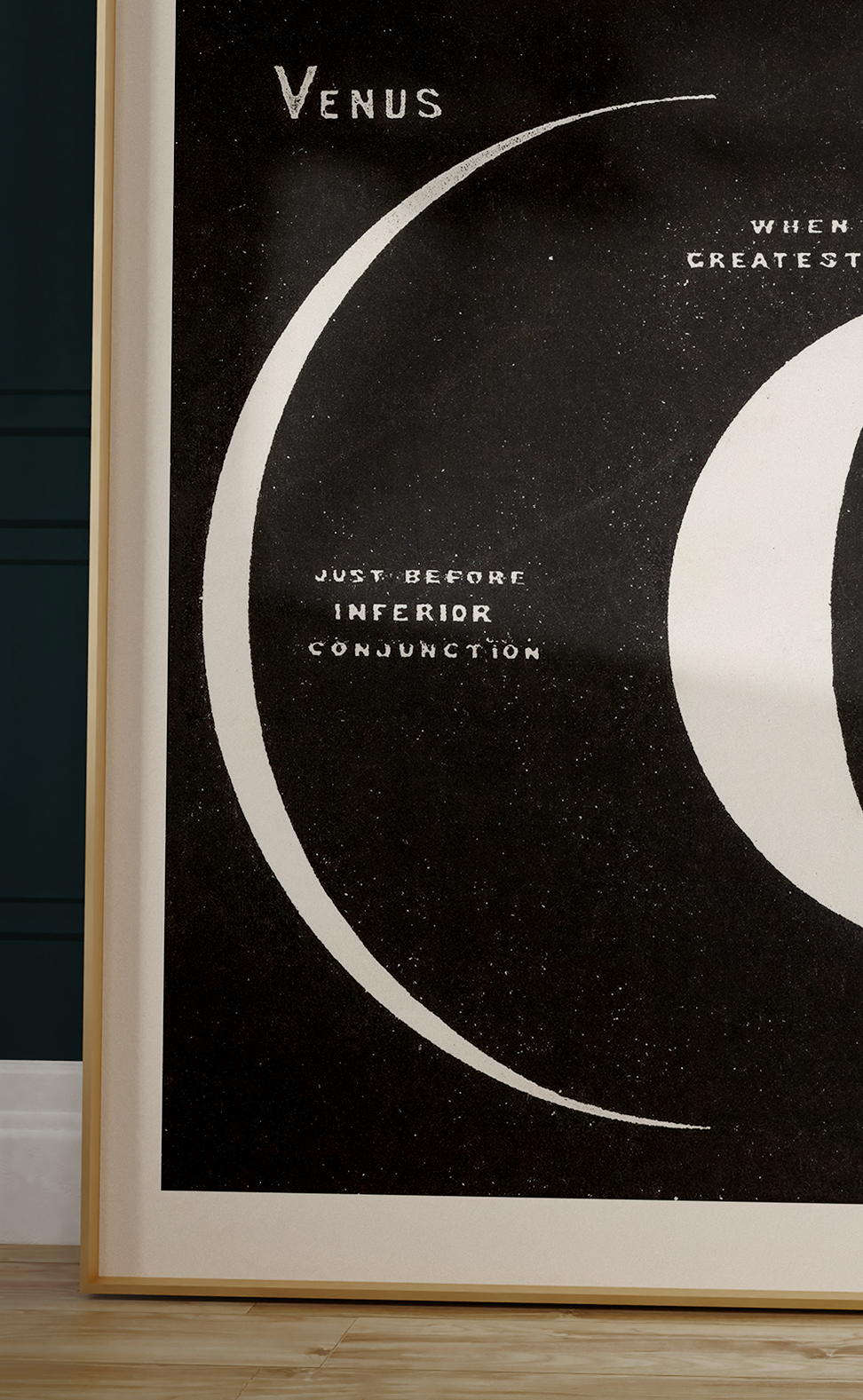
Mars reaches its greatest apparent size during opposition, when Earth passes between Mars and the Sun and the two planets are at their closest. Venus behaves differently. Because it orbits closer to the Sun than Earth, it passes through phases much like the Moon. When Venus appears as a thin crescent, it is actually much closer to us than when it appears nearly full.
Charts like this helped astronomers understand planetary motion long before spacecraft visited either world. By comparing these changing apparent sizes with careful observations, they refined measurements of planetary orbits and distances across the Solar System.
The illustration comes from Robert Stawell Ball’s An Atlas of Astronomy, one of the great popular astronomy books of the late nineteenth century.
Editor’s note
Editor’s note
I chose this print because it transforms something difficult into something obvious.
At first glance, it feels almost like a piece of modern graphic design. Then you realise that every circle and every crescent represents a real astronomical observation.
There is also something timeless about the pairing of Mars and Venus. Beyond astronomy, they have become enduring symbols of war and love, strength and beauty, conflict and attraction. This print quietly brings those two worlds together.
Restoration
Restoration
This image has been carefully prepared for fine art printing.
Dust, stains, scanning artifacts, and tonal inconsistencies are corrected by hand where needed. The file is then checked for sharpness, tonal range, and print quality.
The goal is not to redesign the original, but to preserve its character while making it suitable for contemporary printing.
Materials
Materials
Printed on Hahnemühle 308 gsm museum-quality fine art paper with a matte finish, or available as a premium 400 gsm canvas mounted in a handcrafted wooden float frame.
Paper prints are shipped unframed and wrapped in acid-free tissue paper.
Shipping
Shipping
All the artwork is printed to order in as little as 2-3 days. We ship everything for free worldwide.
Share

Our artwork is printed on Hahnemühle Fine-Art 308 gsm paper, founded in Germany in 1584 Hahnemühle makes one of the best fine-art paper available today.