


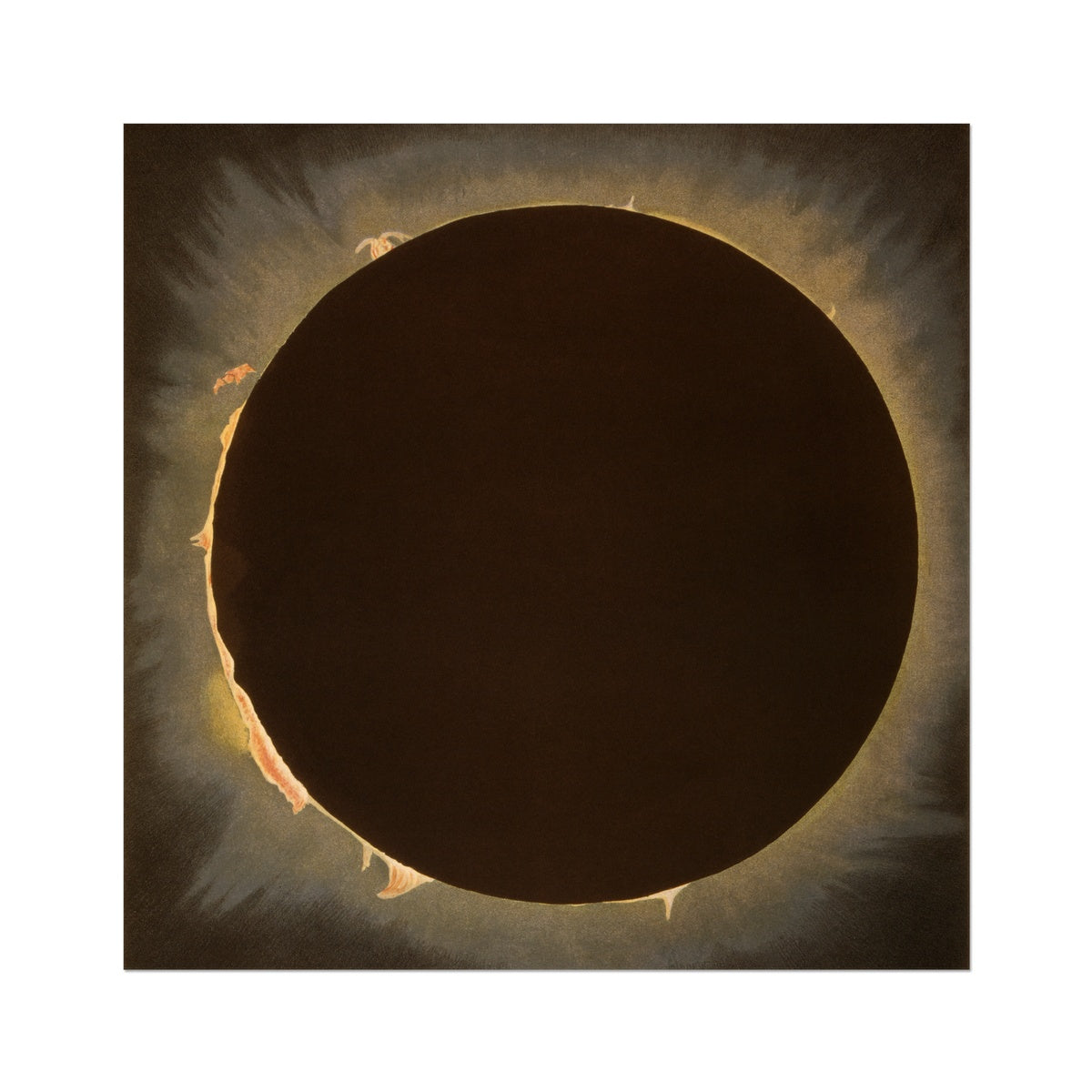
Appearance of phenomena immediately after the beginning of totality, 1862
Appearance of phenomena immediately after the beginning of totality, 1862
A total eclipse revealed something the Sun normally keeps hidden.
For a few brief minutes, the Moon uncovered the mysterious solar corona, turning one of nature’s rarest spectacles into a scientific breakthrough.
Couldn't load pickup availability
Appearance of Phenomena Immediately After the Beginning of Totality depicts the total solar eclipse of 18 July 1860, observed near Miranda de Ebro, Spain, by the British astronomer Warren De La Rue.
De La Rue was among the pioneers of astronomical photography. Using a specially designed photoheliograph, he recorded the eclipse with an unprecedented level of precision. His observations helped demonstrate that the luminous corona surrounding the Sun was a real solar feature, rather than an optical illusion created by Earth’s atmosphere.
Part scientific record and part work of art, this illustration captures a moment when careful observation transformed a spectacular natural event into lasting scientific knowledge.
Restored from the original and reproduced as a museum-quality fine art print.
The Story
The Story
The total solar eclipse of 1860 marked a turning point in the study of the Sun.
For centuries, astronomers debated the nature of the glowing halo that appears during totality. Was it part of the Sun itself, or simply an effect produced by Earth’s atmosphere?
Warren De La Rue’s photographs, together with observations made by other astronomers across Spain, provided some of the strongest evidence yet that the corona truly belonged to the Sun. The eclipse also revealed immense solar prominences rising above the Sun’s edge, helping establish them as genuine solar phenomena.
At a time when photography was still a young technology, these observations demonstrated its extraordinary scientific value. For the first time, fleeting celestial events could be recorded with a precision that surpassed even the most skilled hand drawings.
Editor’s note
Editor’s note
This is one of the images that made me want to start this collection.
It documents a real observation, yet feels almost painterly. The richness of the chromolithograph, the subtle colours and the dramatic contrast between the dark silhouette of the Moon and the luminous corona make it difficult to believe it was created as scientific documentation.
I never tire of looking at it.
Restoration
Restoration
This image has been carefully prepared for fine art printing.
Dust, stains, scanning artifacts, and tonal inconsistencies are corrected by hand where needed. The file is then checked for sharpness, tonal range, and print quality.
The goal is not to redesign the original, but to preserve its character while making it suitable for contemporary printing.
Materials
Materials
Printed on Hahnemühle 308 gsm museum-quality fine art paper with a matte finish, or available as a premium 400 gsm canvas mounted in a handcrafted wooden float frame.
Paper prints are shipped unframed and wrapped in acid-free tissue paper.
Shipping
Shipping
All the artwork is printed to order in as little as 2-3 days. We ship everything for free worldwide.
Share



Our artwork is printed on Hahnemühle Fine-Art 308 gsm paper, founded in Germany in 1584 Hahnemühle makes one of the best fine-art paper available today.
High quality, a unique item!
It is beautiful! Thank you!
this is beautiful - thank you!