


Spectra of Various Sources of Light, 1882
Spectra of Various Sources of Light, 1882
Every star leaves a unique fingerprint in light.
Learning to read those fingerprints transformed astronomy forever.
Couldn't load pickup availability
Spectroscopy changed astronomy forever.
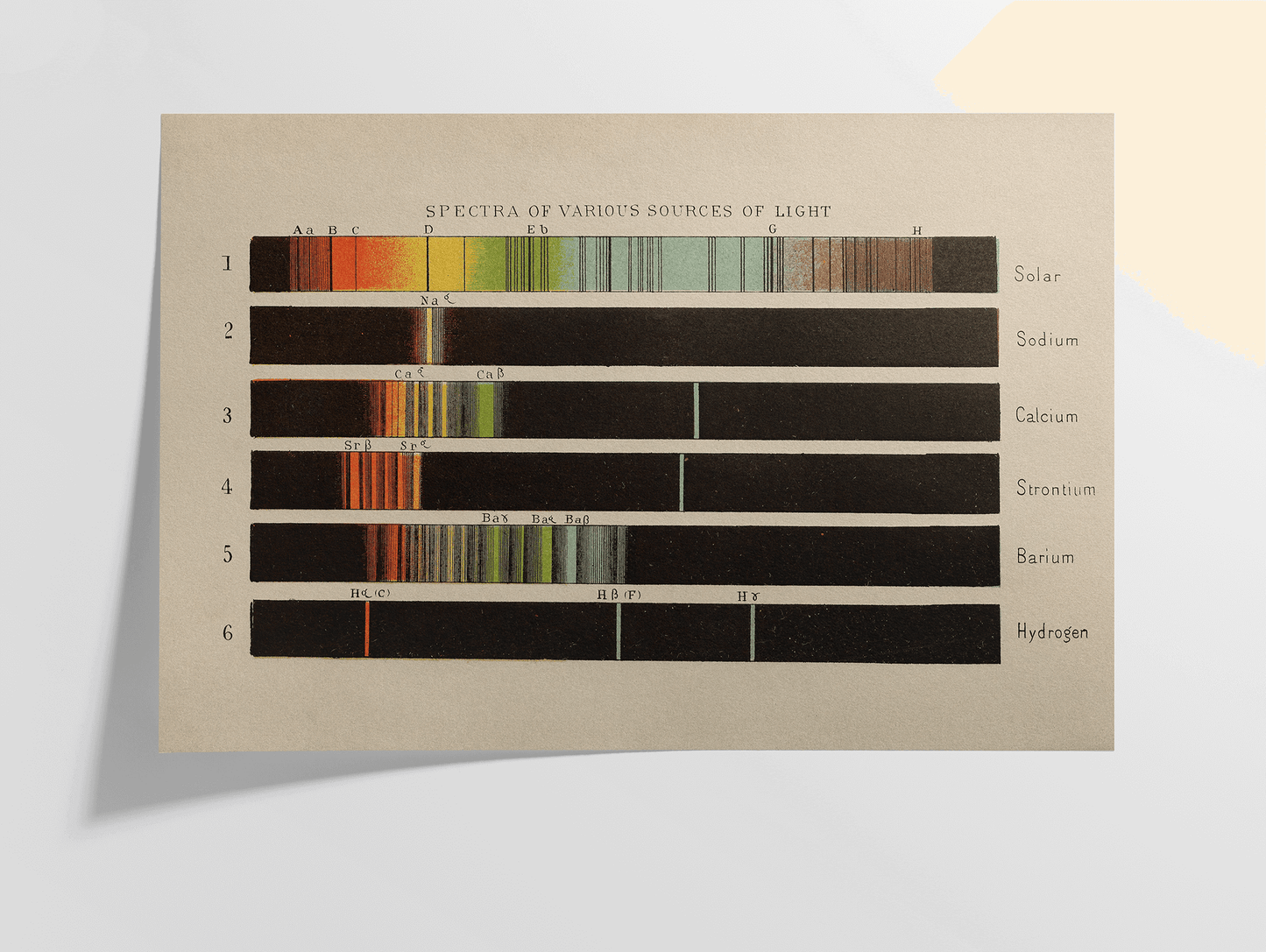
Spectra of Various Sources of Light was published by Potter, Ainsworth & Co. in 1882. The chart compares the spectra produced by different sources of light. By then, scientists had discovered that every chemical element absorbs and emits light in its own distinctive pattern.
For the first time, it became possible to determine what distant stars were made of without ever visiting them.
Today, spectroscopy remains one of astronomy’s most powerful tools. It reveals the composition, temperature, motion and magnetic fields of stars and galaxies, and has helped uncover everything from black holes to planets orbiting distant suns.
Restored from the original and reproduced as a museum-quality fine art print.
The Story
The Story
The study of light changed our understanding of the universe.
In the seventeenth century, Isaac Newton showed that white light could be separated into a spectrum of colours using a prism. Two centuries later, scientists such as Joseph von Fraunhofer, Gustav Kirchhoff, and Robert Bunsendiscovered that every chemical element leaves a unique pattern of dark or bright lines within that spectrum.
These spectral lines became a universal language.
By comparing them with light arriving from the Sun and distant stars, astronomers could identify the elements present without ever leaving Earth. It was one of the first moments in history when humanity learned the composition of objects it could never touch.
The principles illustrated in this chart remain fundamental today. Spectroscopy is used to study galaxies, measure the expansion of the universe, analyse the atmospheres of exoplanets, and investigate the environments surrounding black holes.
Editor’s note
Editor’s note
Unlike a telescope or a map, this image does not show an object.
It shows a method.
A way of reading the universe through light.
I chose this chart because it reminds us that some of the greatest discoveries come not from looking farther, but from learning to look differently.
It is both a scientific instrument and a remarkably elegant piece of graphic design.
Restoration
Restoration
This image has been carefully prepared for fine art printing.
Dust, stains, scanning artifacts, and tonal inconsistencies are corrected by hand where needed. The file is then checked for sharpness, tonal range, and print quality.
The goal is not to redesign the original, but to preserve its character while making it suitable for contemporary printing.
Materials
Materials
Printed on Hahnemühle 308 gsm museum-quality fine art paper with a matte finish, or available as a premium 400 gsm canvas mounted in a handcrafted wooden float frame.
Paper prints are shipped unframed and wrapped in acid-free tissue paper.
Shipping
Shipping
All the artwork is printed to order in as little as 2-3 days. We ship everything for free worldwide.
Share



Our artwork is printed on Hahnemühle Fine-Art 308 gsm paper, founded in Germany in 1584 Hahnemühle makes one of the best fine-art paper available today.
It was a perfect wedding gift for my brother!
Wunderschön, so wie ich es mir vorgestellt habe.