


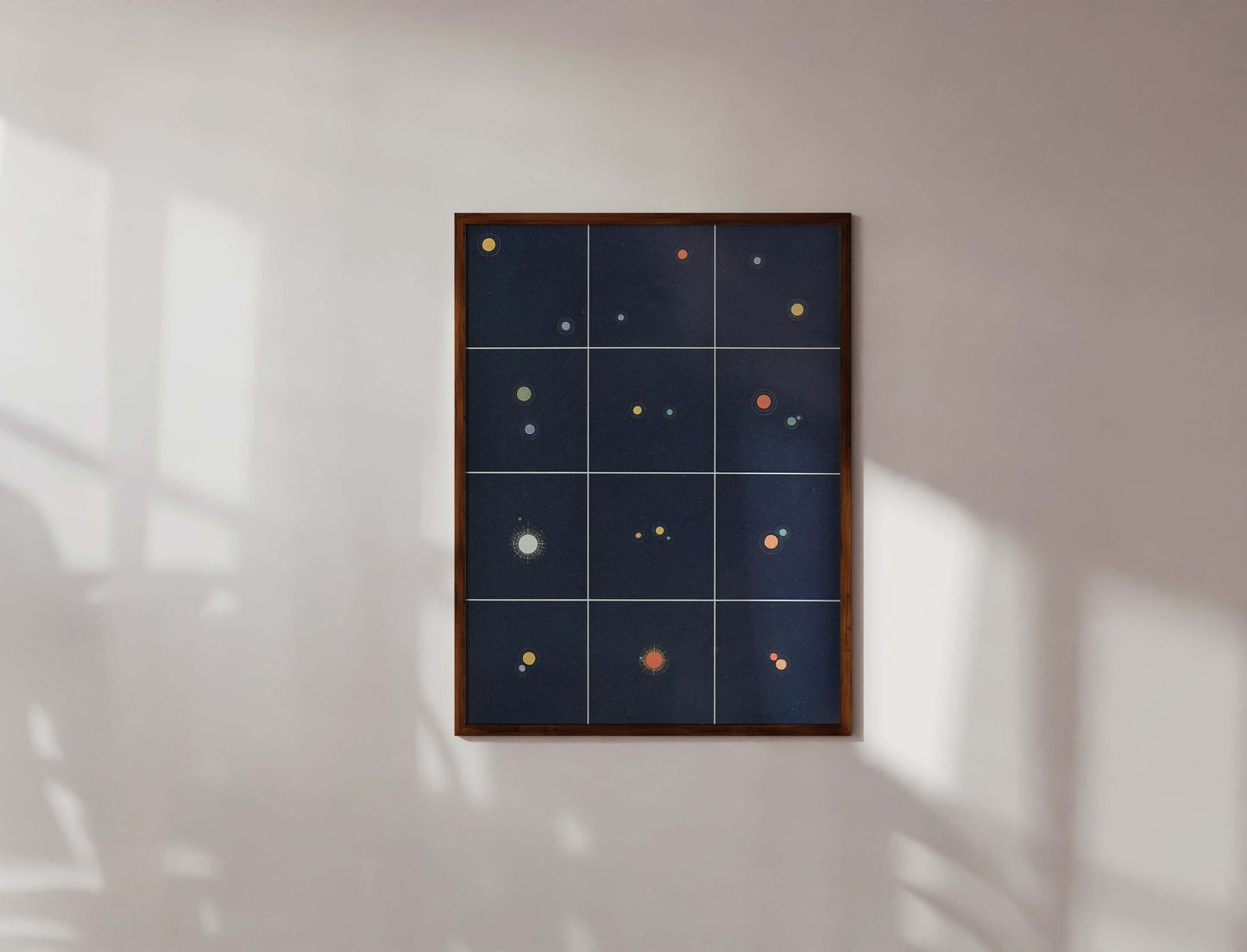
Stars of Multiple Colours, 1923
Stars of Multiple Colours, 1923
Stars have colours.
Beautiful and scientifically accurate, this illustration transforms a familiar night sky into a map of stellar diversity.
Couldn't load pickup availability
Stars of Multiple Colours was published in 1923 in Le Ciel by Lucien Rudaux and Alphonse Berget. The illustration celebrates one of astronomy’s simplest yet most revealing observations: stars come in many colours.
To the naked eye, these differences can be subtle. Through careful observation, astronomers discovered that a star’s colour is directly linked to its surface temperature and physical properties, making colour one of the most important clues to understanding stellar evolution.
Restored from the original and reproduced as a museum-quality fine art print.
The Story
The Story
By the early twentieth century, astronomers had begun to understand that a star’s colour was far more than an aesthetic feature. It provided a direct clue to its temperature, composition and stage of evolution.
Hot blue stars can reach surface temperatures exceeding 30,000°C, while cooler red stars may be only a tenth as hot. Between these extremes lie white, yellow and orange stars, each representing different physical conditions and evolutionary stages. Our own Sun, for example, is a yellow star of intermediate temperature.
Illustrations like this helped communicate these discoveries to a wider audience at a time when astronomy was becoming increasingly visual. Published in Le Ciel in 1923, it combines scientific accuracy with the refined graphic style that characterises the work of Lucien Rudaux, one of the great astronomical illustrators of the twentieth century.
Editor’s note
Editor’s note
I like images that permanently change the way I look at the world.
After spending time with this one, I found myself looking up at the night sky differently. The stars were no longer simply bright or dim. They each had their own colour and, with it, their own story.
That’s exactly the kind of image I want in this collection.
Restoration
Restoration
This image has been carefully prepared for fine art printing.
Dust, stains, scanning artifacts, and tonal inconsistencies are corrected by hand where needed. The file is then checked for sharpness, tonal range, and print quality.
The goal is not to redesign the original, but to preserve its character while making it suitable for contemporary printing.
Materials
Materials
Printed on Hahnemühle 308 gsm museum-quality fine art paper with a matte finish, or available as a premium 400 gsm canvas mounted in a handcrafted wooden float frame.
Paper prints are shipped unframed and wrapped in acid-free tissue paper.
Shipping
Shipping
All the artwork is printed to order in as little as 2-3 days. We ship everything for free worldwide.
Share



Our artwork is printed on Hahnemühle Fine-Art 308 gsm paper, founded in Germany in 1584 Hahnemühle makes one of the best fine-art paper available today.
This review has no content.