


Total Eclipse of the Sun, 1882
Total Eclipse of the Sun, 1882
The Sun’s hidden atmosphere.
Visible only for a few minutes during a total solar eclipse.
Couldn't load pickup availability
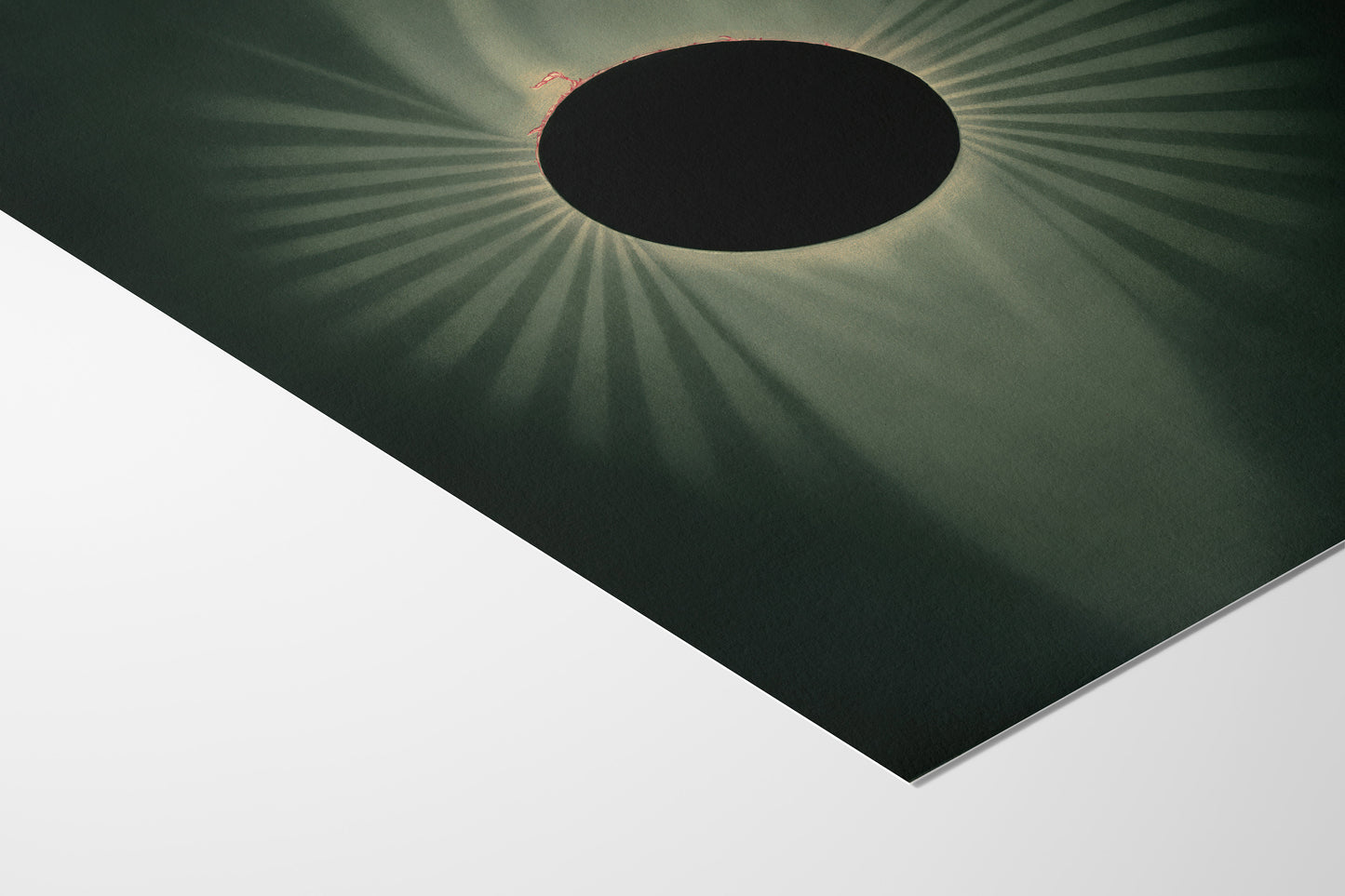
Total Eclipse of the Sun was published in 1882 as part of Étienne Léopold Trouvelot’s celebrated Astronomical Drawings. The remarkable plate captures the total solar eclipse observed in Wyoming on 29 July 1878.
The dramatic black silhouette, delicate rays of the corona and subtle green tones give the image an almost graphic quality while faithfully recording one of astronomy’s rarest spectacles. During totality, the Moon completely covers the Sun, revealing the solar corona, normally hidden by the Sun’s overwhelming brightness.
Restored from the original and reproduced as a museum-quality fine art print.
The Story
The Story
For most of human history, the solar corona remained one of astronomy’s greatest mysteries. It could only be observed during the brief moments of a total solar eclipse, when the Moon blocked the Sun’s brilliant surface.
Trouvelot travelled to Creston, Wyoming Territory, to observe the eclipse of 29 July 1878. Working directly at the telescope, he produced one of the most celebrated artistic records of the event. Long before colour astrophotography became possible, astronomers relied on skilled observers like Trouvelot to capture details that cameras often failed to record.
Published in 1882, The Trouvelot Astronomical Drawings became one of the finest collections of astronomical illustrations ever produced, admired equally for their scientific precision and extraordinary beauty.
Editor’s note
Editor’s note
I chose this print because it feels almost impossible.
The black circle is perfectly still, while the corona seems alive, flowing outward in delicate rays and clouds of light. More than a scientific illustration, it feels like a quiet portrait of the Sun revealing something it usually keeps hidden.
Restoration
Restoration
This image has been carefully prepared for fine art printing.
Dust, stains, scanning artifacts, and tonal inconsistencies are corrected by hand where needed. The file is then checked for sharpness, tonal range, and print quality.
The goal is not to redesign the original, but to preserve its character while making it suitable for contemporary printing.
Materials
Materials
Printed on Hahnemühle 308 gsm museum-quality fine art paper with a matte finish, or available as a premium 400 gsm canvas mounted in a handcrafted wooden float frame.
Paper prints are shipped unframed and wrapped in acid-free tissue paper.
Shipping
Shipping
All the artwork is printed to order in as little as 2-3 days. We ship everything for free worldwide.
Share



Our artwork is printed on Hahnemühle Fine-Art 308 gsm paper, founded in Germany in 1584 Hahnemühle makes one of the best fine-art paper available today.