


Lunar Wall Mosaic LEM-1B, 1963
Lunar Wall Mosaic LEM-1B, 1963
Before spacecraft reached the Moon, it first had to become a map.
This mosaic helped turn a distant celestial body into navigable terrain.
Couldn't load pickup availability
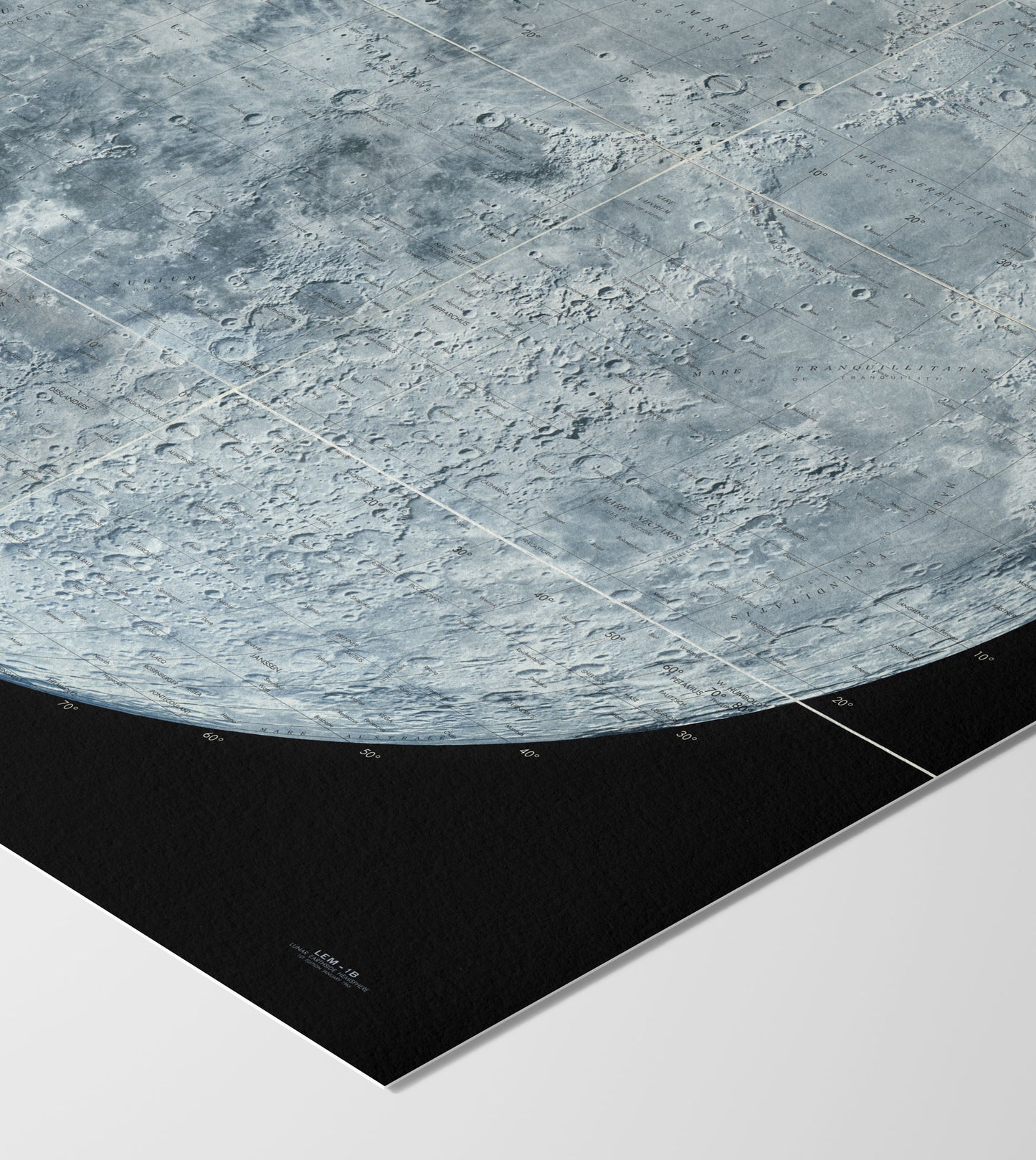
Created by the United States Air Force’s Aeronautical Chart and Information Center, the Lunar Wall Mosaic LEM-1B presents the Earth-facing side of the Moon at a scale of 1:2,500,000. Compiled in 1962 and published in 1963, it belongs to the moment when the Moon was changing from a distant object of observation into a place that might soon be reached.
The image was assembled from photographs taken at Mount Wilson, McDonald and Pic du Midi observatories. Different views were corrected, enlarged and joined to create a clear, continuous reference surface, more useful than any single photograph could be.
Its purpose was practical: to help scientists, cartographers and engineers study the Moon as terrain. Yet the result is also quietly extraordinary. Many nights of observation, from different instruments and different parts of the world, were brought together to make one shared image of another world.
Restored from the original and reproduced as a museum-quality fine art print.
The Story
The Story
How do you make a reliable map of a world that never presents itself in quite the same way twice?
Seen from Earth, the Moon appears constant. In practice, it shifts. Its apparent position rocks slightly through a cycle known as libration, revealing different slivers around its edges. The angle of sunlight changes continually, causing craters to emerge, flatten or disappear into shadow. Atmospheric conditions alter the sharpness of every photograph. Even the finest observatory could capture only one configuration of light, position and weather at a time.
The makers of the Lunar Reference Mosaic were therefore not searching for a single perfect photograph. They were attempting something more ambitious: to construct one.
Sections were selected from twenty-four photographs taken at three observatories: Mount Wilson in California, McDonald in Texas and Pic du Midi in the French Pyrenees. The images were copied to a common scale, corrected to a standard lunar position and fitted together. Photographs with comparable solar illumination were chosen so that craters and mountain ranges would appear under a broadly consistent light.
This produced a Moon that no observer had ever witnessed at one moment. Its continuity was manufactured from separate nights, separate instruments and locations thousands of kilometres apart.
Positioning the fragments required an underlying framework. The mosaic relied primarily on selenographic measurements assembled in the Orthographic Atlas of the Moon, edited by planetary astronomer Gerard Kuiper in 1960. These coordinates allowed the photographs to become more than an accumulation of impressive views. They became a controlled map whose parts could be compared, indexed and used as a foundation for further work.
The first USAF Lunar Reference Mosaic had been compiled in 1960. Two years later, the project was rebuilt with improved photographic material and issued in three sizes. LEM-1B was the largest, a two-sheet wall mosaic with a lunar disc more than 1.4 metres across. The official catalogue later described the series as one of the most requested resources in the lunar map inventory, used both for display and as a base for scientific indices.
Its timing was significant. In 1962, the Moon remained a place known almost entirely through light received on Earth. Yet engineers, cartographers and astronomers were already treating its surface as territory that would need to be located, compared and navigated.
The mosaic belongs to that brief threshold. It is the old observational Moon, photographed through the atmosphere, reorganised in preparation for a new age in which machines, and soon people, would approach the surface itself.
Editor’s note
Editor’s note
The lunar photograph itself appears almost seamless. What interrupts it are the traces of the object that carried it: the folds, panel divisions and registration lines of a large working chart designed to be opened, aligned and overlapped on a table.
I find those marks essential. They prevent the image from becoming a purely abstract Moon and return it to the world of use. This was not made simply to be admired. It was handled, consulted and assembled as an instrument.
The scan preserves both things at once: an extraordinarily coherent view of another world, and the physical structure through which that view was made practical. It reveal the human effort around it.
Restoration
Restoration
This edition is based on the original 1963 Lunar Wall Mosaic LEM-1B. The principal blocks of technical text have been removed to create a quieter, more contemplative presentation, while the original title and date have been retained as part of the map’s historical identity.
The image has been carefully prepared for fine art printing. Dust, stains, scanning artefacts and tonal inconsistencies are corrected by hand where needed. The file is then checked for sharpness, tonal range and print quality.
The aim is not to redesign the original, but to preserve its photographic and material character while adapting its presentation for a contemporary setting. The folds, panel divisions and registration lines remain visible, preserving the physical history of a chart designed to be opened, aligned and used.
Materials
Materials
Printed on Hahnemühle 308 gsm museum-quality fine art paper with a matte finish, or available as a premium 400 gsm canvas mounted in a handcrafted wooden float frame.
Paper prints are shipped unframed and wrapped in acid-free tissue paper.
Shipping
Shipping
All the artwork is printed to order in as little as 2-3 days. We ship everything for free worldwide.
Share



Our artwork is printed on Hahnemühle Fine-Art 308 gsm paper, founded in Germany in 1584 Hahnemühle makes one of the best fine-art paper available today.