


Various Colours of the Moon during Eclipses, 1882
Various Colours of the Moon during Eclipses, 1882
Not every Blood Moon is the same.
Every total lunar eclipse paints the Moon in a different palette, from pale copper to deep crimson.
Couldn't load pickup availability
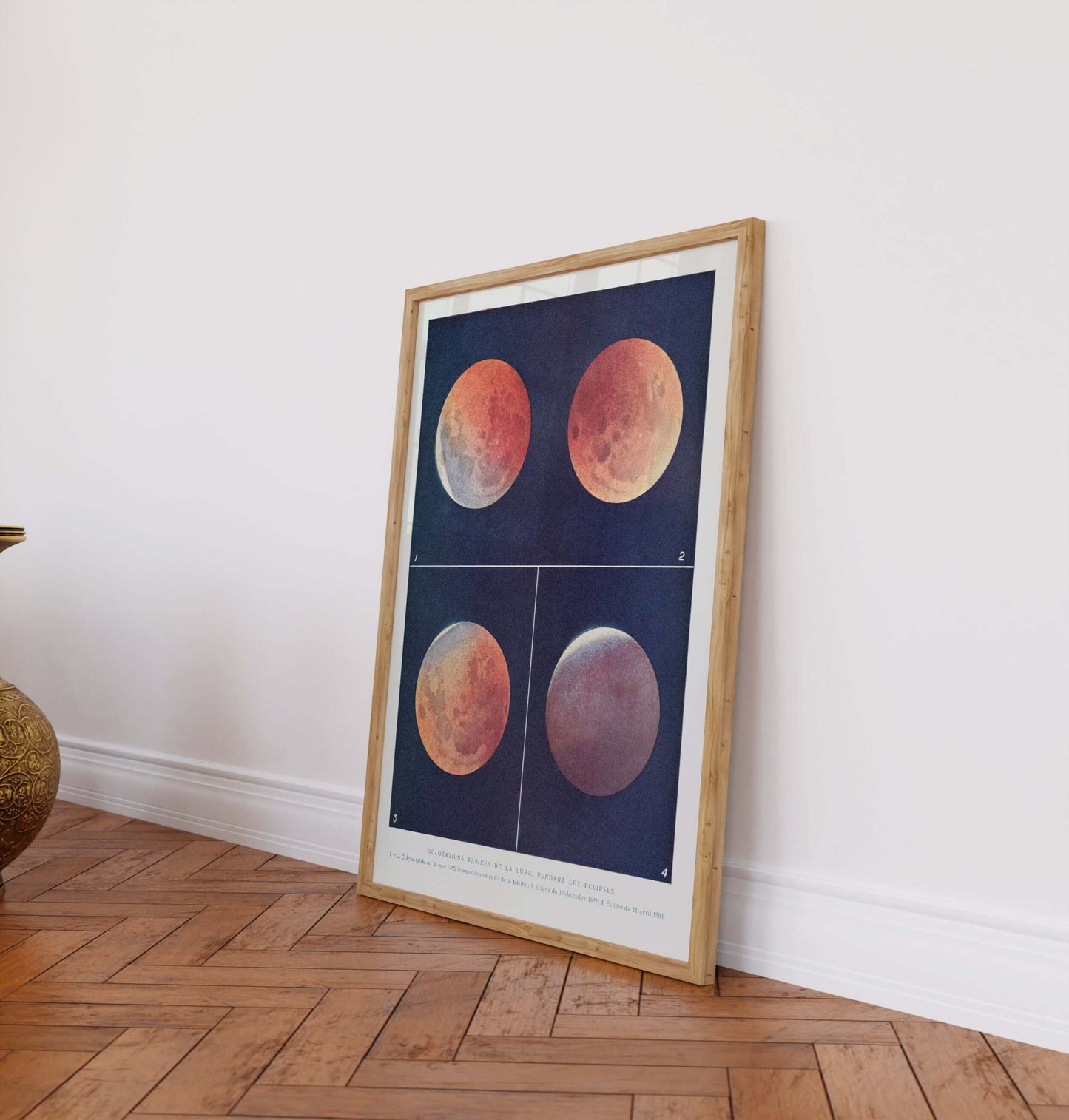
Various Colours of the Moon During Eclipses was published in 1923 in Le Ciel. This remarkable plate compares the colours of the Moon during four different total lunar eclipses.
Its subtle palette of reds, oranges and violet-grey tones is as beautiful as it is scientific, revealing how Earth’s atmosphere transforms each eclipse into a unique event.
Restored from the original and reproduced as a museum-quality fine art print.
The Story
The Story
A total lunar eclipse occurs when the Earth passes directly between the Sun and the Moon. Although the Moon enters Earth’s shadow, it rarely disappears completely. Instead, sunlight passing through Earth’s atmosphere is bent toward the lunar surface, bathing it in shades of copper, orange and deep red.
The exact colours depend on the state of Earth’s atmosphere at the time. Dust from volcanic eruptions, smoke, pollution and even atmospheric humidity all influence how much light reaches the Moon, making every total lunar eclipse unique.
Published in 1923, Le Ciel brought together the scientific expertise of physicist Alphonse Berget and the extraordinary illustrations of astronomer and artist Lucien Rudaux. Rather than depicting a single eclipse, this plate compares several observations, revealing how dramatically the Moon’s appearance can vary from one event to the next.
Editor’s note
Editor’s note
I chose this print because of its colours.
They feel almost impossible. Soft reds, warm ochres and muted violets that seem closer to a painter’s palette than to astronomical documentation.
It’s a reminder that some of the most beautiful colours in nature don’t belong to flowers or sunsets, but to the brief moments when our own planet casts its shadow across the Moon.
Restoration
Restoration
This image has been carefully prepared for fine art printing.
Dust, stains, scanning artifacts, and tonal inconsistencies are corrected by hand where needed. The file is then checked for sharpness, tonal range, and print quality.
The goal is not to redesign the original, but to preserve its character while making it suitable for contemporary printing.
Materials
Materials
Printed on Hahnemühle 308 gsm museum-quality fine art paper with a matte finish, or available as a premium 400 gsm canvas mounted in a handcrafted wooden float frame.
Paper prints are shipped unframed and wrapped in acid-free tissue paper.
Shipping
Shipping
All the artwork is printed to order in as little as 2-3 days. We ship everything for free worldwide.
Share



Our artwork is printed on Hahnemühle Fine-Art 308 gsm paper, founded in Germany in 1584 Hahnemühle makes one of the best fine-art paper available today.